If you want to study abroad, let me tell you it will be difficult to choose between the American and Canadian education systems. Both countries are known among international students for top-class universities, diverse student communities, and excellent career opportunities.
However, as you research them, you will come across differences in the American vs Canadian education system. From funding, tuition fees, and admission requirements to teaching styles and post-graduation opportunities, each of these countries offers a different educational experience.
Moreover, understanding their differences is crucial for making informed decisions and choosing a place that aligns with your preferences, financial situation, and long-term goals. In that regard, this blog will help you.
How's the Canadian education system?
The Canadian education system is publicly funded and administered at the provincial level rather than by the federal government. This leads to a more standardised educational experience across the provinces. Moreover, the curriculum and grading systems remain consistent across the country.
Also, the Canadian education system is famous because of its inclusivity, academic excellence, and practical learning.
Education starts at the age of 6 or 7 and continues until the age of 16 or 18. It comprises 3 major levels: the elementary (16), junior high (79), and high school (1012). Quebec is followed by CEGEP, which is a preparatory program before university admission.
According to the World Population Review, the education system of Canada ranks 19th. However, before you apply, explore the best online degrees in Canada.
How's the American education system?
The American education system is one of the most diverse education systems. It functions through fifty different state systems; therefore, there is a lot of variation in terms of standards, graduation requirements, and curriculum across different regions. Moreover, it is funded by local property taxes.
It generally includes elementary (K5), middle (68), high school (912), and higher education.
The American education system is quite popular for offering flexibility, a wide range of extracurricular activities, and comprehensive research centers.
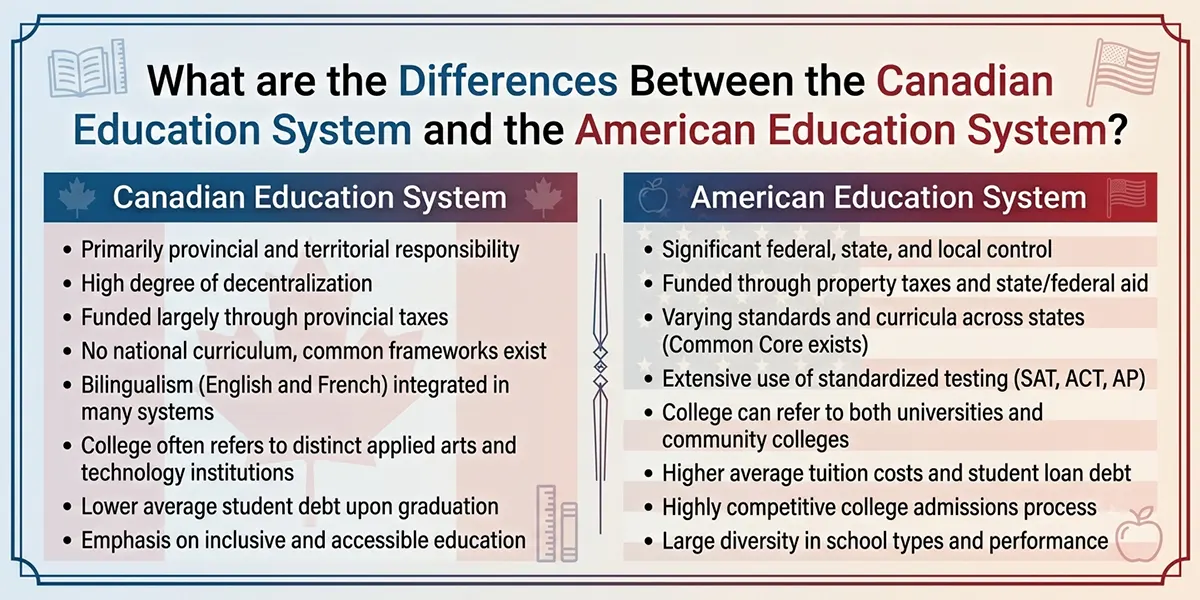
Canadian education vs American education system:
Key difference 1: Educational governance:
The major difference between the American vs. the Canadian education system is how it is governed.
| Canada | America |
|---|---|
| This education system is more centralised and uniform across the different provinces. This is because each province manages its own education system and there is no national ministry of education to govern the whole country. As a result, most schools are equal in quality. | This education is decentralised at both state and local levels. Each state has complete control over its education policies. Moreover, the US schools are funded by local property taxes. As a result, there is variation in curriculum and educational standards across the different states. However, the federal government can influence education policies through funding initiatives or national programs. |
What's the difference?
Canadian education system: consistent in educational quality. Many students want a Guide to Study in Canada for Indian Students.
American education system: diverse and flexible.
Key difference 2: Curriculum structure:
| Canada | America |
|---|---|
| As provinces control the curriculum, it is aligned with local students' needs. Moreover, it also includes emphasis on bilingual education, particularly in Quebec, promoting French and English proficiency. Also, the Canadian education system emphasises critical thinking, problem-solving, and practical application of knowledge. The curriculum is standardised across the provinces, so broader learning outcomes and grading scales are consistent across all provinces. | As the curriculum is controlled by individual states, this education system is diverse. It offers great flexibility. Students can choose from advanced placement courses, honors classes, elective subjects, and specialised academic tracks. |
Key difference 3:School funding:
| Canada | America |
|---|---|
| Schools in Canada are funded through provincial tax revenues. It leads to uniform educational quality across the regions. However, inequality may exist between the wealthy and less privileged areas, but the gap is much smaller compared to the gap in America. | The schools in the US are funded by local property taxes. However, this creates disparities in terms of extracurricular activities, technology and class sizes even within the same state. |
Canadian education system funding leads to educational equity, and the American education system funding can lead to significant disparities.
Key difference 4: Standardised testing:
| Canada | America |
|---|---|
| In the Canadian education system, students face fewer standardised tests across the entire educational journey. Assessments are based on classroom performance, projects, assignments, and participation. | In the American education system, standardised testing plays a major role. Students have to encounter state assessments, the SAT, ACT, and advanced placement exams. Moreover, these tests have an impact on university admission decisions. |
Overall, Canadian students face less academic pressure as they don't have to deal with standardised testing. However, it's the opposite when it comes to the US education system.
Key difference 5: University admission process:
| Canada | America |
|---|---|
| Canadian universities focus on academic performance. Moreover, university admission usually depends on high school grades, prerequisite courses or the past academic record. | American universities have a holistic admission process. They usually evaluate GPA, SAT/ACT scores, personal essays, recommendation letters, leadership experience, volunteer work, and extracurricular activities. Moreover, the students who easily get admitted to universities are the ones with academic as well as personal achievements. |
If you have good grades, go for the Canadian education system. However, if you have a lot more achievements beyond grades, then go for the American education system.
Key difference 6: The cost of education:
| Canada | America |
|---|---|
| Canadian universities have lower tuition fees. The average tuition fees for international students range from CAD 20,000 to CAD 40,000. Moreover, Canadian universities do provide scholarships, but the options are limited. | On the other hand, American universities charge a lot more. Three international students have to pay USD 25,000 to USD 70,000. Moreover, private universities are more expensive. However, US universities offer a lot of scholarships and financial aid opportunities so you can also take advantage of that. |
Key difference 7: College vs university structure:
| Canada | America |
|---|---|
| In the Canadian education system, the colleges and universities have different purposes. The colleges focus on applied learning, technical training, and career preparation. However, universities focus on degrees and research, etc. | In the American education system, the terms college and university are used interchangeably, as the distinction is less rigid. |
Key differences 8: Class sizes and learning environment:
| Canada | America |
|---|---|
| In the Canadian education system, we can observe smaller class sizes, customised instruction and more focus on teacher-student interaction. It leads to a more supportive learning environment. | In the American education system, class sizes differ; public universities have large lecture halls, whereas smaller private colleges have smaller class sizes. |
Key difference 9: Research opportunities:
| Canada | America |
|---|---|
| Canadian universities emphasise research in higher education and contribute to global innovation. | In America, there are many top-class research institutions. As a result, students gain experience working in advanced laboratories, major research grants, and industry partnerships, and so on. |
Key difference 10: Student life and campus culture:
| Canada | America |
|---|---|
| Canadian universities are known for diversity, inclusivity, safety, and a collaborative environment. Moreover, the campus culture focuses on academics and less on other co-curricular activities. | American universities are known for their vibrant culture. This is because students can participate in sports, fraternities, organisations, leadership programs, and so on. |
If you want a quieter and academically focused environment, go for the Canadian education system, and if you want a highly active campus culture, then the US education system would be more suitable.
Key difference 11: Work opportunities during studies:
| Canada | America |
|---|---|
| In Canada, students can work part-time during their studies. Also, they can access the post-graduation work permit. | In America, international students may face more obstacles to working during studies. They are often confined to on-campus jobs, optional practical training, or curricular-related training. |
Key difference 12: Immigration pathways after graduation:
| Canada | America |
|---|---|
| Another advantage of the Canadian education system is the immigration system, as graduates can easily qualify for the postgraduate work permits, provincial nominee programs or permanent residence pathways. | On the other hand, the American education system is not so flexible when it comes to the immigration pathways. Students can rely on OPT programs or employer sponsorship. However, it is a complex and competitive process. |
Key difference 13: Grading systems:
| Canada | America |
|---|---|
| The Canadian education system includes percentage grades or letter grades. | The American education system includes a GPA system or test grades. |
Key difference 14: Global recognition and reputation:
| Canada | America |
|---|---|
| The Canadian education system is known for its affordability, high quality of life, and strong employability. | The American education system is famous for its world-renowned universities, research leadership, extensive alumni networks, and global influence. |
Key difference 15: Student performance:
| Canada | America |
|---|---|
| Canadian students rank among the top performers worldwide. Graduation rates are also consistently high. | American students show mixed performance, and scores differ based on socioeconomic factors and state-level disparities. Graduation rates vary from state to state. |
Education in Canada vs America: what to choose?
You can choose the Canadian education system if you want affordable tuition fees, high education quality, easier immigration pathways, smaller class sizes, and a safer learning environment. On the other hand, you can choose the American education system if you want flexible, vibrant campus life, a prestigious university network, and extracurricular experiences.
Therefore, there is no one answer to whether Canadian or American education is better. It all depends on your preferences and goals.
All in all!
Canadian and American education systems both are highly recognised and reputable. However, they differ in many aspects. The Canadian education system is known for its affordability, educational uniformity, student-friendly immigration policies, and supportive learning environment. In contrast, the American education system is known for its flexibility, world-class research opportunities, vibrant campus life, and globally recognised universities.
However, before a student chooses between the two countries, they must consider their own preferences regarding tuition costs and long-term plans etc.
Lastly, whether you study in America or Canada, you will decide your own career. Therefore, work hard regardless of your destination.
FAQs:
Who has better education, Canada or the US?
It depends on your goals. Canada is known for being affordable and providing easier pathways to permanent residence. However, the USA has more reputable and globally known institutions.
Is Canada's education system better than the US?
If you want to know whether Canada or the United States has a better education system, then let me tell you that it depends on the level of schooling you want and your personal goals.
What is the #1 country for education?
There is no single #1 country for education because rankings differ based on different factors.
What are the differences in funding for public schools in Canada vs. the US?
Public schools in Canada are funded at the provincial level and American schools are funded by local property taxes.
How is Canadian education different from American education?
Canada’s system is much more uniform and heavily focused on equality. The U.S. system is decentralized and relies heavily on local funding.
Which is better to study in Canada or the US?
Choose Canada if you need affordability, post-study work permits, and a clear path to permanent residency. Choose the United States if you need academic prestige and high career earning potential.
Where does Canada rank in education?
Canada ranks among the top 10 education systems in the world.
Where does America rank in education?
The United States ranks in the top 10 to top 30 globally.
Should I study in America?
Studying in America provides world-class degrees, global networking, and flexible curricula, and so on.
Canada vs USA Job Opportunities: which one to choose from a career perspective?
Choosing between Canada and the USA depends heavily on your industry, income goals, and lifestyle preferences.