Canada has over 650,000 international students, which shows the interest of students around the world in Canadian education.
The country has both public and private education, while public education is offered, funded, and run by federal, provincial, and local governments.
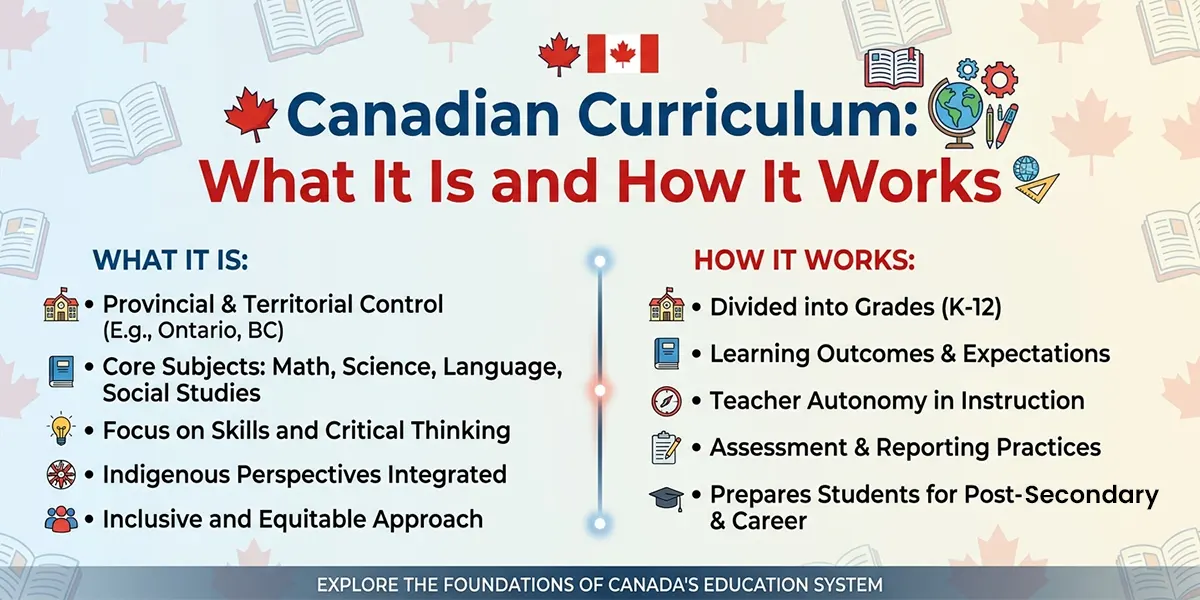
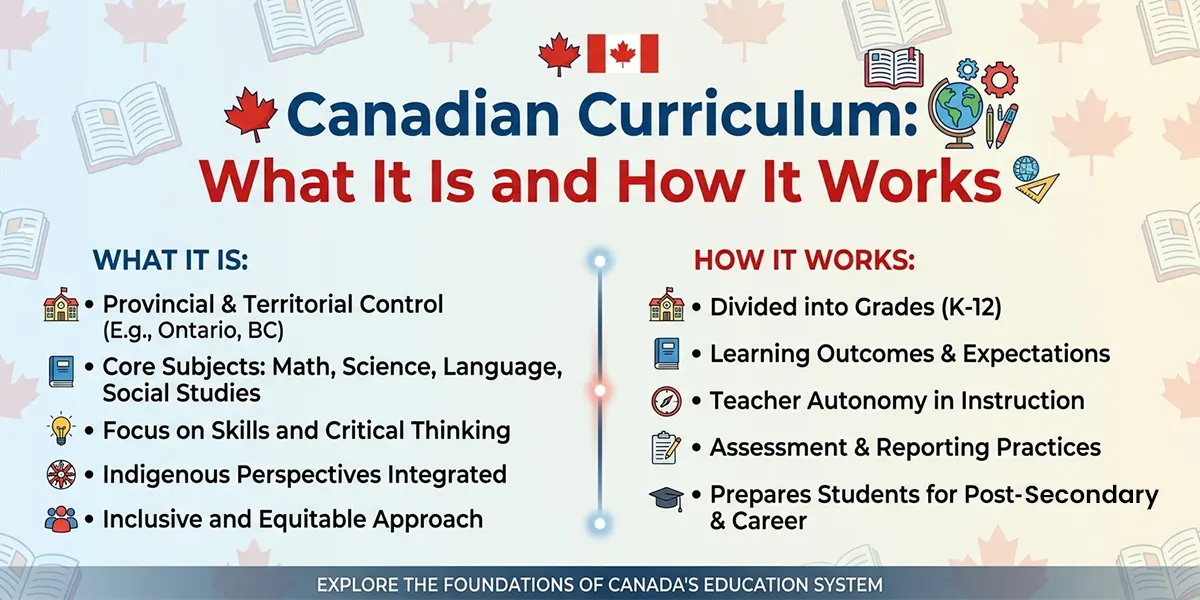
The Canadian curriculum is supervised by every province. There are plenty of minor variations in the Canadian education system. Like the type of programs provided, minimum and maximum age requirements, and so on.
That is why grasping the complete Canadian curriculum outline is essential. The reason is that it ensures learning alignment and supports unified changes for shifting learners. And assist in adopting guidance to achieve competency-based, complete learning standards.
Whether you are a parent navigating the school system or a global student who wants to learn about the curriculum of Canada before moving, this guide is for you.
How the Canadian Curriculum works in Different states
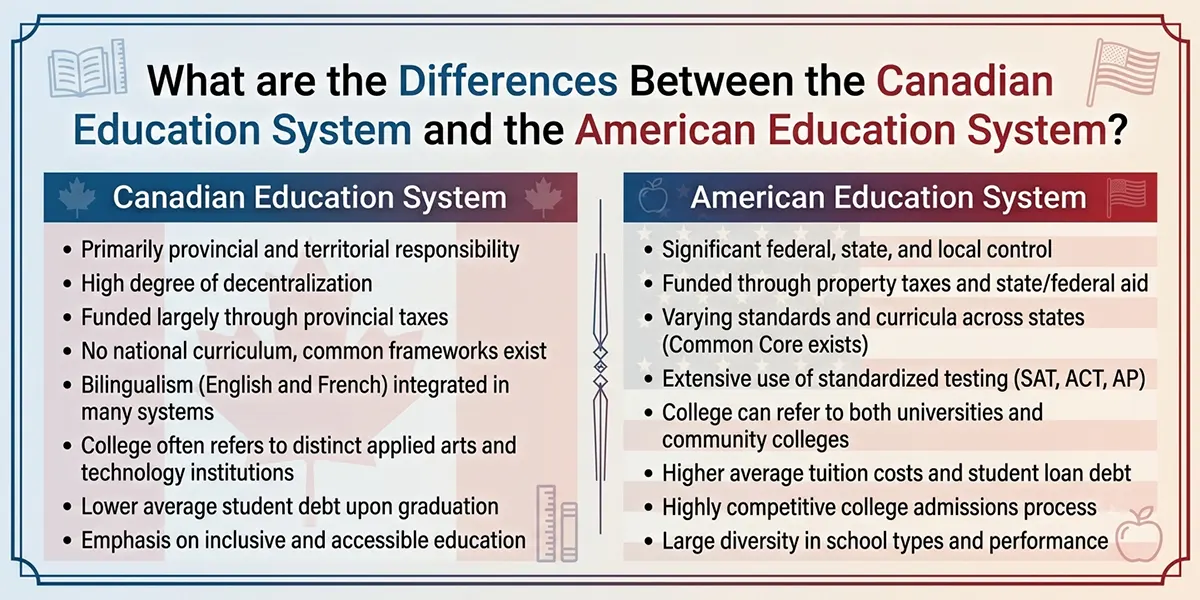
There is no single Canadian Curriculum, as education is a largely provincial jurisdiction in Canada.
Rather, Canada has 13 distinct K-12 educational systems, one for every province andthe 3 territories.
Currently, the Canadian school ranks 5th globally, handling more than 14260 students. It also serves 5.5 million students in the Public system.
Here is the curriculum syllabus in Canada.
- Ontario (OSSD)-The Ontario Secondary School Diploma is the most commonly used and famous framework. It is used both across Canada and globally.
- British Columbia (BC)-It focuses on a new, competency-based method, and it leads to the BC Dogwood diploma.
- Alberta- This state is famous for identical testing and a highly academic, traditional university prep focus.
- Other provinces: There are plenty of other provinces in Canada that offer a similar syllabus: Quebec, Manitoba, Saskatchewan, Nova Scotia, New Brunswick, Prince Edward Island, and Newfoundland. These provinces operate and design their own unique provincial syllabi and graduation requirements.
Canadian curriculum books and homeschooling
In the Canada region, homeschooling offers families the chance to customize their kids’ education, providing flexibility and adapted methods of learning.
As homeschooling in Canada is fully legal, it is a provincial responsibility, which means there is no single national Canadian Syllabus.
Moreover, there are tons of homeschooling services available in the country. Parents can consider getting access to reliable syllabus resources and support services like reliable homeschooling guidance and Assignment help services to help their kids get premier education and academic guidance.
Some of the most popular Canadian curriculum book publishers:
- Popular Book Company: One of the widely-trusted book publishers that offers a comprehensive range of books on all subjects, and subject-specific book series. It offers a complete range of the Canadian curriculum, including workbooks of multiple subjects like Maths, Science, English, Social Studies, History, etc.
- Pearson Canada: A pretty promising name that publishes textbooks according to different provinces' curricula. From Hands-on Science resources to a complete K-3 math curriculum, they are a decent name in curriculum book publishing in Canada.
- Nelson Education: The leading Canadian book publisher of the K-12 school system, offering digital and printed educational resources as per different provincial standards.
Canadian Homeschool Curriculum Resources
Here is the vast array of Canadian key sources for Homeschool education that are accessible in 2026.
Government Resources
- These websites for Provincial Ministries of Education offer support on homeschooling regulations and syllabus requirements.
- It accesses complete information on Canadian home education.
Curriculum Resources
- It looks for Canadian Curriculum Press and Pearson Canada for detailed homeschool syllabi to assist with provincial standards.
- Another curriculum resource, such as the homeschool hub, provides a wide array of printable materials, lessons, and activity sheets.
Online Learning Platforms
- Find Khan Academy, IXL Learning, and Duolingo for engaging and collaborative online lessons.
- Other platforms, such as the Canadian virtual school, offer official online courses for learners across grades.
Textbooks and Workbooks
- Amazon Canada and Chapters Indigo provide a wide array of textbooks, workbooks, and learning resources.
- For discounted and reasonable prices, think about bookware for used textbooks.
Local Libraries
- Use public libraries for books, DVDs, and other resources.
- Obtain the perks of online library resources and e-books
Homeschool Support Groups
- Join CHEC (Canadian Home Educators of Canada) for networking, support, and workshops.
- Connect with provincial homeschooling groups for your kids' Canadian Curriculum.
Virtual Field Trips
- Finally, visit Google Arts & Culture for virtual museum tours and National Geographic Kids for virtual field journeys.
- These virtual field trips provide access to historical sites and natural phenomena.
Core Components and Subjects of the Canadian Curriculum
The Canadian syllabus is divided into many subject areas that focus on academic excellence and personal development.
From basic subjects like Maths, Science, and History, to future-focused subjects, Canada focuses on providing a comprehensive education to its students in all fields, according to the interests of the student.
Elementary Framework Grades 1 to 8
Here is the elementary framework used in Canadian schools.
- Grades 1 to 6: At this level, most of the frameworks consist of Language Arts, Science and Technology, Mathematics, Social Studies, Health and Physical Education.
- Grade 7: Although the subjects are pretty much the same at this level, the concepts and learning strategies become more advanced. Grade 7 is usually the transition to junior high or middle school.
- Grade 8: From strengthening the core concepts to building basics for the new subjects, this grade tries to enhance formative assessment and increase project-based learning.
Secondary Framework Grades 9 to 12
- Grade 9- At this level, students have to choose elective practical skills like coding, any other IT skill, food or nutrition, or any other subjects available.
- Grade 10: From workplace skills to civic duties, along with higher levels of mathematics and science subjects. Through hands-on learning and facing and solving real-world scenarios, this level helps students prepare a base for their future by giving them a basic understanding of the careers they want to pursue.
- Upper-level courses - Grades 11 and 12 - The focus shifts to college/university preparation as students earn credits, which are typically around 80-100 hours (based on the province). Students take 8 courses every year (typically a 4-semester program).
Specific Subjects
Here are the different subjects and their core components in the Canadian curriculum.
1. Language Arts
- Reading, writing, listening, and speaking skills
- Literature analysis and comprehension
- Creative and analytical writing
2. Mathematics
- Number sense and operations
- Algebra, geometry, and data management
- Problem-solving and real-world applications
3. Science
- Life sciences, physical sciences, and Earth sciences
- Inquiry-based experiments and research projects
- Environmental awareness and sustainability
4. Social Studies
- Canadian history and geography
- Civic education and government
- Cultural diversity and global issues
5. Physical Education and Health
- Physical fitness and sportsmanship
- Nutrition and mental health
- Life skills and safety education
6. Arts Education
- Visual arts, music, drama, and dance
- Creative expression and cultural appreciation
- Integration of arts across subjects
7. Technological Education
- IT and digital literacy
- Coding, robotics, and STEM projects
- Ethical considerations in technology use
Complete Canadian Curriculum
The Canadian education system comprises three key parts: elementary, middle school, and high school.
Normally, kids start in KG and then progress to grade 12. The academic year in Canada usually runs from September to June.
The whole structure is globally similar. Every province and territory has its own rules about the syllabus and school organization.
Whereas each book in the Canadian syllabus provides a unique basic framework for a 36–week school year. A specialist Canadian curriculum provider for international schools observes that the curriculum works ideally as a guide or review material.
Plus, the syllabus needs additional resources to create a detailed, solid, long-term learning plan.
Here is the detailed syllabus of the Canadian Curriculum from KG to 8.
Complete Canadian Curriculum Kindergarten
It is the initial education for children, typically aged 4-5 years old.
The KG is a foundation that comprises subjects like Maths, English, with basic shapes, sorting, counting and story comprehension.
These subjects underline smart, vivid artworks, and the key aim is to develop foundational literacy and number skills. Students enjoy playful activities in KG.
For a complete curriculum overview or practice, parents can consider this book by PopularBookCompany.
The book covers the basic subjects like:
- Maths
- Science
- Social Studies
- Arts
Complete Canadian Curriculum Grade 1
The basic curriculum of grade 1 is typically the same as the subjects Maths, Science, Social Studies, and Arts. But the differences in the curriculum of different states are:
- Ontario focuses more on foundational reading and writing.
- Alberta prefers more hands-on learning approaches in all subjects.
- British Columbia emphasizes learning over memorizing with basic awareness.
- Quebec calls in Cycle 1, in which both grades 1 and 2 are combined, and they focus on math structure and sequences.
- Manitoba combines learning, communication and problem solving.
For better understanding, you can teach this book from the curriculum of grade 1 by borrowing from the Internet Archive.
Complete Canadian Curriculum Grade 2
The subjects of grade 2 are usually the same, which works as the baseline for students. But varies as per the province. The base subjects are Maths, Science, Social Studies, and English. For a better understanding of the subjects and topics covered in the curriculum, you can visit or even download the book of the Canadian curriculum grade 2, as this book is a pretty handy resource for homeschooling.
Complete Canadian Curriculum Grade 3
At this level, kids are usually about 8-9 years old, so schools focus on more mathematical multiplication, division, geometry, perimeter, area, and even a bit of data handling. In English, they focus on vocabulary, stories, and essays. In science, they teach basic solid, liquid, and gas concepts with the animal life cycle and in Social Studies, concepts like geography, heritage and culture are the area of focus. And to get the basic overview of other topics and a basic outline, you can check out this book from the grade 3 curriculum.
The differences in the curriculum of different states are:
-
Ontario focuses on financial literacy, basic coding, and hands-on practice of mathematical concepts. You can go and explore this Ontario grade 3 curriculum book for all the subjects, approaches and activities.
-
British Columbia appreciates the ideas and skills above traditional learning. You can visit their website for a curriculum overview.
-
Alberta uses a framework called LearnAlberta that consists of modern curricula updates with basic knowledge.
-
Nova Scotia focuses heavily on mathematical assessments.
Complete Canadian Curriculum Grade 4
The whole focus shifts from learning to read to reading to learn as students are expected to solve and understand more complex academic concepts in different subjects. The subjects are the same in this grade too, but the level of complexity increases. French language usually becomes an addition to the Canadian curriculum from grade 4. For a standard curriculum for grade 4, you can view or even download this basic or general standard curriculum for grade 4.
All the different states focus on boosting critical thinking, logical reasoning, and problem-solving skills with different approaches and activities.
Complete Canadian Curriculum Grade 5
Grade 5 is a level where the courses and topics become more in-depth, detailed and research-oriented. From practical scientific experiments to building projects and completing certain tasks. The Canadian curriculum shifts the focus from basic learning to advanced and a bit complicated topics in the subjects. For additional practice or to use as a resource, students can explore this book from the grade 5 curriculum.
The subjects of the curriculum remain the same, but the approach changes. From theoretical learning to executive functioning skills and hands-on experiments, every state curriculum is designed accordingly.
Complete Canadian Curriculum Grade and Basic Curriculum Focus.
At this level, the average age of the student is around 11-12 years, which is considered an ideal age group to start teaching children about responsibility, time management, health and physical fitness, and leadership. The change in the dimension of learning is crucial, as by this grade, students gain foundational knowledge across different subjects. For a better understanding of the standard and the most basic outline of the grade 6 curriculum, you can go through this book.
| Province/State | Basic Role & Structure | Focus of the Curriculum |
|---|---|---|
| Alberta | Last year of elementary school | Applied math and core literacy skills |
| Quebece | Last year of elementary school | French language learning |
| Ontario | Last year of the junior division | Shift towards STEM, financial literacy, and basic technical skills |
| British Columbia | Intermediate or middle school transition | Heavy emphasis on Big Ideas |
Complete Canadian Curriculum Grade 7 and Core Focus in Different Provinces
Grade 7 is the beginning of the advanced levels, and the learning dimension shifts towards analytical thinking, deep research, and basic preparation for high school. For practice and more in-depth research, you can review the basic Grade 7 curriculum book for better preparation and homeschooling.
| Province/State | Core Focus | Focus on Science and Maths | Focus of Social Studies |
|---|---|---|---|
| Alberta | Advanced literacy and problem-solving | About planet Earth, solar system, geology, and a bit of complex mathematical formulas | History of Canada, Migrations, Early era, and cultural history |
| Quebece | French Culture & Language Immersion | Algebraic concepts and equations. Life cycle | History of the state, country, and civic responsibilities |
| Ontario | Practical learning & STEM | Ecosystem, principles and laws, coding, and financial management | Canadian history, different eras, and geography of the country |
| British Columbia | Heavy focus on Ideas | Climate change, evolution and algebra | Different cultures, social and environmental aspects |
Complete Canadian Curriculum Grade 8, Core Subjects and Different Approaches.
In some provinces, grade 8 is the final year of elementary school, like in Ontario. In some provinces, it is the first year of high school and the final year of middle school, like in BC. In Alberta, it is considered the middle year of junior high; in Quebec, it is Secondary II.
Different regions use different approaches; for example, Quebec uses QEP, while others focus on subject-specific and concept-based approaches.
The core subjects in grade 8 are typically Math, English Language, History & Geography, Science & Technology, Physical Health & Education, Applied Science, Second language, and Arts. A good resource for getting an idea of the most general topics, subjects, and exercises in the Canadian curriculum is this Grade 8 Canadian curriculum workbook for guidance and homeschooling.
Complete Canadian Curriculum Grade 9 Overview and Differences.
All the same subjects as grade 8, with 2 electives and optional courses (Arts, CTE, and Business Studies).
In Ontario, it marks the official beginning of the credit system, and they use a de-streamed curriculum to strengthen students' core competencies, boost students’ productivity and prepare them for high school.
British Columbia uses the Core Competencies framework, and the Know-Do Model of learning them completely relies on memorization.
Alberta uses PATs to evaluate students' progress and prepare them for grade 10, and integrates CTF to enhance their practical skills, such as coding, business, and even communication.
Grade 9 is considered Secondary III in Quebec, and students focus more on the French language and culture, developing practical skills and learning advanced concepts in their subjects.
For an understanding of the level of complexity of the topics of grade 9, you can go through this workbook.
Complete Canadian Curriculum Grade 10, Key Curricular Changes and Transitions
At grade 10, students are usually 15 to 16 years old. And the changes in the curriculum depend on the province in which the student is. In Ontario, the main focus is on preparing students for the OSSLT, a mandatory graduation requirement.
British Columbia prioritizes personalized learning aligned with students’ interests. The Alberta curriculum focuses on deeper knowledge in the core subjects. The Quebec curriculum prepares students for CEGEP, pre-university tracks, and technical skills.
For a more in-depth understanding of the Canadian curriculum for grade 10, you can take a look at this workbook as a resource for grade 10 that will help you to get a good idea about the complexity and basic outline of grade 10.
Complete Canadian Curriculum Grade 11 and Academic Pathways
The academic difference is significant in the Canadian curriculum, as the country does not follow a single curriculum and provinces manage their education system.
The base subjects remain the same, such as mathematics, social studies, and the English language. But science branches become specialized subjects, which prepare students for university specialization in these subjects. Elective subjects and specialized pathways can also be selected from subjects like Business & Computer Science, technological education and much more.
| Province | Academic Focus & Differences in Curricula |
|---|---|
| Ontario | Course streaming/ Selecting a path: Students have to choose between College (C), University (U), Mixed (M), and Workplace (W) course paths |
| British Columbia | Focuses on provincial graduation assessments |
| Alberta | This is considered the foundation for grade 12 with complex maths and science concepts |
| Quebec | In Quebec, it is the final year of high school. And the focus for the students is to secure the diploma and enter the 2-year CEGEP before entering university |
Complete Canadian Curriculum Grade 12
The main focus is to prepare students for their post-secondary pathways, with different provinces using different approaches. Ontario focuses on university and college preparation, and they use school-based grading and literacy assessment. The main focus of the British Columbia curriculum is to help students with their inquiry-based learning and strengthen their core competencies. Alberta focuses on subject mastery for future pathways. And in Quebec, high school ends at grade 11, so this isn’t applicable to them. You can use this educational workbook for the Canadian curriculum for grade 12 to understand everything easily.
Thorough Subject Material Breakdown
1. English Language Arts
- Early years K-2: The early years of the Canadian curriculum heavily emphasize the ABC, basic phonics, sight words, opposites, and early tracking or writing.
- Elementary Years 3 to 6- In elementary years 3 to 6, the changes shift from basic into reading and understanding methods, vocabulary increasing, formal grammar rules, punctuation, and organizing writing.
- Intermediate years 7 to 8- The intermediate years progress to critical text analysis, tricky essay structure, advanced vocab, and media literacy.
2. Mathematics
- Early Years K-2: In K-2, the math creates number sense via foundational counting, shape identification, sorting, and patterns. And it also teaches introductory addition and subtraction.
- Elementary years 3 to 6: In 3 to 6 years of elementary school, students face challenges in multiplication, division, fractions, decimals, basic measurement, data management, and so on.
- Intermediate Years 7 to 8-The intermediate years clarify basic pre-algebraic theories and concepts such as exponents, square roots, fractions/ ratios, and financial applications of percentages.
3. Science and Tech
- Early Years- K-2- The initial years of science and tech focus on grasping basic concepts such as local plants, common animals, and seasons.
- Elementary years 3 to 6: The elementary years investigate habitats, human body systems, forces, properties of materials, and electricity.
- Intermediate years 7 to 8: These 7 to 8 years handle hard systems and theories like cell theory, mechanical advantage/work systems, water systems, and fluid dynamics.
Social Studies/ History and Geography
- KG to 6: From KG to grade 6, schools combine local communities, heritage, citizenship, early global societies, and basic Canadian identity.
- Grade 7 and 8 History: Grade 7 and 8 examine chronological growth, such as the creation of Canada from 1850 to 1890. It is changing societies from 1890 to 1914.
- Grade 7 and 8 Geography: It examines human settlement patterns, global land use, quality-of-life indicators, and economic sectors.
Specialized Programs and Curriculum Variations
Whereas the basic syllabus offers a consistent foundation, there are tons of provinces that provide specialized programs in order to adapt to a vast array of interests and needs.
Examples of Specialized Programs
- French Immersion and bilingual education
- Advanced Placement (AP courses
- Vocational and technical training
- Special education supports
Indigenous Perspective and Inclusion
- A combination of indigenous history and culture
- Culturally responsive pedagogy
- Offer assistance to many students and provide accommodations
Assessment and Evaluation in the Canadian Curriculum
The assessment methods of Canada focus on monitoring progress and providing instruction.
Types of Assessment
Here are the different kinds of assessments available in the Canadian Curriculum
- Formulate assessments such as quizzes, class activities
- Summative assessments such as final exams and projects
- Portfolios and presentations
- Uniform provincial tests
Grade and Reporting
- Clear and fair grading practices
- Consistent and daily report cards
- Parent-teacher conferences for criticism
Need help with the assessment and evaluation of the Canadian Curriculum?
Reach out to our qualified and experienced tutors. Our tutors graduated from the top-ranked Canadian Universities and have exceptional expertise in every aspect you need guidance.
Connect Now
How Canadian Schools Prepare students for the future
The comprehensive Canadian curriculum focuses on equipping students with essential skills for success in higher education, careers, and civic life.
Skills Developed
- Critical thinking and problem-solving
- Collaboration and teamwork
- Digital literacy and technological skills
- Creativity and innovation
- Cultural awareness and global citizenship
Post-Secondary Pathways
- University admissions
- College diploma programs
- Apprenticeships and vocational training
- Entry into the workforce with transferable skills
The Structure of the Curriculum System in Canada
1. Pre-Elementary KG
The KG programs provide for young students aged 4 to 5, prior to starting elementary school at the age of 6.
These schools are provided by public, private, and federal entities. Also, they offer schools for the visually and hearing impaired.
While plenty of schools and programs provide for kids who turn 5 on a particular date in the school year.
KG is optional in many jurisdictions, even though it is mandatory in Nova Scotia and New Brunswick.
There are a few jurisdictions that provide full- day programs. But others offer half-day programs. On the other hand, some of them offer both simultaneously.
In addition, KHD studies prepare students for the next level of primary education. And students are also presented with the ABC, pre-reading, math skills, music, art, and play.
2. Primary Elementary
Primary education in Canada is mandatory for all students between the ages of 6 and 7. Every student obtains 6 years of primary education.
Here is the standard 6-year Canadian Syllabus.
- Grade 1 (ages 6–7)
- Grade 2 (ages 7–8)
- Grade 3 (ages 8–9)
- Grade 4 (ages 9–10)
- Grade 5 (ages 10–11)
- Grade 6 (ages 11–12)
Generally, students study under one teacher for the complete school year, in a single classroom. Students study a wide range of subject areas, from math to reading to language arts to science to geography to social studies.
Indeed, the complexity increases as the students move to the next level. And every student needs to adopt and develop new skills.
While special education programs normally have 1 to 4 instructional assistants assigned, they generally rely on the type and severity of the student’s disabilities.
Secondary
There are two levels of secondary education in Canada: intermediate junior high school and high school.
1. Intermediate Education
When students effectively finish their last year of elementary or primary education, or even grade 6. After that, they move to intermediate education.
The intermediate education is a 2-year educational phase.
- Grade 7 (ages 12–13)
- Grade 8 (ages 13–14)
While studying, grade 7 students usually participate in the practice of joining different classrooms for the duration of the day. Also, different teachers study for different classes.
Every teacher who teaches grade 7 is a specialist in their subject matter. And they all have subject matter teaching certifications.
Grade 7 organizes students for the future world and secondary education or high school. The subjects taught are similar to those in primary school.
However, the difficulty increases hugely as the students move to the next phase.
2. High school
Once students have effectively finished grade 8, they are promoted to high school. It is a 4-year program, and here is the breakdown of a high school.
- Grade 9 (ages 14–15)
- Grade 10 (ages 15–16)
- Grade 11 (ages 16–17)
- Grade 12 (ages 17–18)
- Grade 12+(ages 18-19) –This is only in the Ontario Provinces
A high school is obligatory for every student in order to stay in high school till they reach the age of 16, regardless of their age.
However, in Ontario and New Brunswick, this is not the scenario, and every student needs to remain in school till at the age of 18.
Once students have finished high school, they are given a diploma. More than 90% of students in Canada complete high school with excellent results and receive a diploma.
In addition, at the high school phase, schools prepare students for a college or university education. Also, they offer them the skills to thrive in the workplace upon graduation.
There are tons of programs offered by Canadian schools, like vocational job training and academic programs. Most of the providers provide a blend of both high school and postsecondary credits.
Post and Secondary
1. Colleges and Universities
Students who graduated from high school can easily apply to a college or university.
In Canada, the term college generally refers to a community college or a technical, applied arts, or applied science school.
Further, they award vocational certifications, diplomas, and associate degrees. A lot of students leverage them as a way to organize and prepare for university education, and they also obtain transferable skills.
On the flip side, others provide college and detail the Canadian curriculum to prepare students for a business, vocation, or diploma. And a certificate as well that would enable them to enter the workplace.
The universities in Canada are higher education institutions that offer a blend of theory and practice. They offer a diverse range of academic programs in many subjects. These are as follows.
- Bachelor's degree: A bachelor's degree, such as a Bachelor of Arts or Bachelor of Science, is an undergraduate degree. It takes 3 to 5 years to finish a program. However, that is totally dependent on the province and class accessibility.
- Master’s degree-A master's degree, like a master of Arts or master of Business Administration, comprises 2 years; it is a postgraduate degree.
- PHD- Finally, the PHD is a specialized postgraduate degree, and it is the most challenging one. It takes 3 to 6 years to finish a PHD degree.
Still unable to finish your assignments at the university level?
Engage our specialists and experienced team of writers at Canada Assignment Help. Our team comprises PhD writers who can help you deliver an original and high-quality paper within a deadline.
Sign Up Now!
International Schools & Niche Programs in Canada
Here are the different international schools that operate in Canada.
1. TFS- Canada’s International School, Toronto
- Address: 306 Lawrence Avenue East, Toronto, ON M4N 1T7
- Annual Cost: About $35,000 CAD. Advantages:
- TFS is the only bilingual school, and it is completely accredited in both languages, English and French.
- It is approved by the IB, the International Baccalaureate Programs.
TS is a globally famous university providing a wide range of bilingual education from preschool to high school.
In addition, the school greets global learners who come from more than 40 different nations. Hence, producing a really global and multicultural setting.
Graduates of the TFS obtain the French national brevet diploma and the Ontario secondary school diploma. Also, the IB Advanced Diploma.
2. Lakefield College School, Ontario
- Address: 4391 County Road 29, Lakefield, ON K0L 2H0 Annual Cost:
- About $65,000 CAD (boarding) Benefits:
- Brilliant natural setting on the beaches of Lake Katchewanooka, with small classes and modified attention with the Outdoor Leadership and Adventure program.
The university was established in 1879. Lakefield College School is a well-known coeducational school. The school is best for academic greatness and a detailed approach to education.
The school also delivers a stimulating learning setting. And they motivate every student's personal growth through a wide range of extra activities.
3. USCA Academy (Mississauga)
- Address: 977 Pantera Drive #2, Mississauga, ON L4W 2W6 Annual Cost:
- Around $18,000 CAD Perks:
- Tons of programs from elementary to high school. Such as Intensive IELTS/TOEFL exam preparation. These programs offer Personalized coaching and quality tutoring.
USCA Academy is a private global school in Canada that provides a complete curriculum framework from quality learning to both local and global students.
There are many great things about the university, such as small class sizes, specialist teaching staff, and an adopted learning method.
4. University of Toronto Schools
- Address: 371 Bloor Street West, Toronto, ON M5S 2R8 Annual Cost:
- Roughly $28,000 CAD Advantages:
- Connected with the University of Toronto, it has a rigorous and stimulating academic program. The university places a strong emphasis on research and innovation.
The University of Toronto is basically a self-governing secondary school; it is notable for its academic excellence.
Both local and international students benefit from a stimulating learning environment and have access to the resources of the University of Toronto.
5. Ashbury College (Ottawa)
- Address: 362 Mariposa Avenue, Ottawa, ON K1M 0T3 Annual Cost:
- Almost $26,000 CAD (day school), $65,000 CAD (boarding) Advantages: –
- IB, the International Baccalaureate program, has great university admission exam results. Also, it has top-tier sports and arts facilities.
Ashbury College is a private school that provides a coeducational education, and it is recognized for providing top-quality education in the Canadian capital.
In addition, the school offers a strict academic program. Also, the school provides many extra activities.
Canadian Curriculum providers for international schools
Here is the best Canadian curriculum offered by the best providers, the Great Canadian adventure curriculum. But first, you have to understand what a great Canadian adventure syllabus is.
What is a Great Canadian Adventure?
Well, the great Canadian adventure is a curriculum; it depends mostly on the Canadian province or territory.
You can either leverage it like a single study for one geographical location. Or you can also run through every one of them for a detailed Canadian syllabus.
The program comprises history, geography, experiential learning, science, cooking, crafting, games, and more. The main aim of these courses is around subjects both directly and roughly pertinent to that unit’s province or territory.
Here are the best providers in Canada that provide a great Canadian Adventure and a complete Canadian curriculum.
1. Provincial Offshore School Programs
Provincial governments in Canada are certified states that assist global schools overseas.
Further, students who graduated from these schools obtain exactly the same high school diplomas as domestic learners.
Here are the top provincial offshore school programs.
- British Columbia (B.C.)- The BC is a Ministry of Education global school program, and it provides certification to a wide range of schools worldwide. Every partner school is checked, and they hire only certified and experienced teachers.
- Ontario: There are tons of school boards and private operators partnering with the Ontario International Schools (OIS framework. These schools are usually handled by groups such as Canadian International School Solutions.
2. Private Franchises and Managed School Networks
A lot of educational management firms provide pre-packaged Canadian syllabi and fluent teaching practice with turnkey operational systems for global school owners.
- Maple Bear is a major global franchise, and its primary focus is Canadian bilingual early childhood and elementary education.
- Canada Global Academy- this reputable provider offers franchise and partnership bundles to global students. It enables them to offer the Ontario Curriculum and also issue the most prominent credits.
3. Curriculum Consulting and Online Course Providers
Tons of schools in Canada do not wish to be a full franchise; however, they want to provide Canadian courses or dual diploma tracks. These quality providers deliver licensing, consulting, distance education, and even academic support, like finding or preparing them for the best online degrees in the country.
- Global learning- Global Education is an official British Columbia Ministry of Education-certified provider of online courses. This provider offers courses to non-resident students who join global schools. The provider provides both synchronous and asynchronous course management.
- Canadian International School Solutions (CISS)-This provides an offer detailing the Canadian curriculum framework, consulting, and approval pathways. And they also provide academic management services for schools that wish to start Canadian programs.
- Global Affairs Canada- Global Affairs Canada provides a detailed, proven directory of registered elementary and secondary schools. But the provider offers a separate provincial syllabus outside Canada.
Why 2026 is the Getaway Year for Schools Providing the Ontario Canadian Curriculum
2026 is a rising year, similar to a breakout year for schools in Canada. These schools have long been providing the Ontario Curriculum.
Further, the curriculum is usually delayed and accepted in execution, and has rewarded schools with a record and tons of chances to prepare broadly.
Exceptional Preparation Time for Schools
There are many reasons why 2026 is the breakout year for every school in Canada. One of them is a lengthy timeline, which enables students to develop a full approach to curriculum execution, and they do not offer rush adoption.
Also, the extended time allowed tutors and educators to polish their teaching methods. Plus, they have the time to develop essential resources, and they train their staff well.
Competitive Advantage for Early Adopters
Schools that work with the reputable Academy Partnership program in Canada have significant control and power compared to their rivals.
At the end of 2026, these early adopters will have a completely trained staff and will have developed resources. And thus, they polish their teaching methodologies, placing themselves as educational leaders.
Thus, the impact of being fully trained will be huge; these schools extend far beyond mere compliance to creating a sense of status.
Here are the tons of perks of using an early adopter.
- Schools that have wisely prepared for the Canadian curriculum and make changes can easily stand out from those that delay it.
- Early Adopters have the opportunity to advance and develop an in-depth execution method.
- Those schools that work with the certified program offer schools with certified and experienced staff. They also polish their teaching practices.
- Finally, schools that gain a competitive advantage gain early preparation. They are also noticeable in many marketing campaigns, student results, and institutional reputation.
Final Note
In the end, navigating the Canadian Curriculum landscape reveals a system that discards one-size-fits-all. This method is ideal and favors localized, extremely effective frameworks.
The reason is that education in Canada normally falls under provincial and territorial jurisdiction. Every one of Canada’s 13 regions has established its own unique pathway.
These usually range from Ontario’s globally renowned OSSD to British Columbia's unique, skills-based framework.
Despite these basic changes, Canada's education system keeps a consistently top worldwide ranking. The country's mastery of a wide range of subjects, such as math, science, and language arts.
Additionally, the main aim of a Canadian education is to develop skills in students’ critical thinking, cultural inclusion, and future-ready tech literacy.
FAQs
1. Is there a centralized national curriculum for everyone in Canada?
Ans: No, the country does not offer a single federal department of education or a national syllabus. But rather than the country offering a provincial and territorial duty.
2. How many education systems are in Canada?
Ans: There are more than 13 separate educational systems handled by the country's reputable ministries of education. Hence, it leads to slight changes in graduation requirements, policies, and specialized programs all over the country.
3. What are the most commonly recognized provincial syllabi in and outside of Canada?
Ans: Two of the most notable and widely used systems in Canada are the Ontario Secondary School Diploma (OSSD) framework and the British Columbia (BC) Dogwood Diploma framework.
4. Are the OSSD Framework and Dogwood Diploma Framework efficient?
Ans: Both of these frameworks are highly valued and respected globally. As a result, creating the best choices for global schools and offshore programs that are operating outside of Canada.
5. How is the School system organized by grade level in Canada?
Ans: Although there are minor changes introduced by providence, there are three primary structures that are typically followed. Pre-Elementary / Kindergarten: Ages 4 to 5 (foundational and play-based learning). Primary / Elementary School: Grades 1 through 6 (ages 6 to 12). And lastly, secondary School: Divided into Intermediate/Junior High (Grades 7 and 8, ages 12 to 14) and High School (Grades 9 through 12, ages 14 to 18).
6. Is homeschooling legal in Canada, and what curriculum does the country follow?
Ans: Yes, indeed, homeschooling is fully legal in all provinces and territories. The key reason is a single national syllabus; parents should follow the particular legal reporting requirements.
7. What are the best textbook and workbook resources for the Canadian Curriculum?
Ans: Prominent and reputable provinces combine and connect materials, such as publication series from the Canadian Curriculum Press and Pearson Canada.
8. Which is the best detailed workbook series to understand the Canadian curriculum?
Ans: Detailed workbook series, such as the complete Canadian curriculum books by famous publishers, are best for organizing reviews. It has a 36-week academic tracking and offers extra homeschool content.
9. How does the Ontario history curriculum manage a wide range of points of view in secondary school?
Ans: The Ontario Canadian and world studies program is heavily focused on topics such as historical inquiry, critical thinking, and a broad global perspective. The outline adds essential, detailed content that highlights the historical involvement and experiences of Indigenous peoples, such as Black Canadians. Also, units devoted to studying universal events such as the holocaust and the Holodomor.
10. What are Canadian Offshore schools?
Ans: There are tons of Canadian offshore schools, all located outside Canada and officially certified. These schools are regularly checked by provincial ministries. The best-known are British Columbia and Ontario. Also, these schools have the best tutors and enable international students to earn a high school diploma from Canadian colleges without even having to move abroad.
11. What is the Great Canadian Adventure curriculum?
Ans: The great Canadian Adventure is basically an illustrious and experimental learning method. This approach is widely used by elementary teachers and homeschoolers. This approach vigorously searches for and investigates Canadian Geography and history through dedicated units for specific provinces or territories. Furthermore, the method includes key elements such as specialized lessons, regional science topics, traditional crafts, cooking, and local games.
12. Why is 2026 regarded as a breakout year for schools accepting the Ontario curriculum?
Ans: 2026 is a strategic success for students implementing the old Ontario framework, thanks to the lengthy preparation timelines set by education ministries. The schools adopt the new Ontario curriculum, from the KG syllabus to the introduction of sweeping educational governance reforms. In addition, the syllabus ensures a consistent, standardized, and high-quality learning experience across all systems.
13. What pathways are available to students after graduating with a Canadian high school diploma?
Ans: There are tons of career pathways accessible in Canada, as the Canadian high school diploma offers flexible, globally recognized qualifications. Students from around the globe, without issue, receive direct admission to the best universities. Also, the country has many community colleges for technical diplomas, vocational and work-based courses, and training.
14. How efficiently is the Canadian curriculum recognized around the globe?
Ans: It is considered one of the premier gold standards for university admissions worldwide. Although the country does not have a single curriculum, its focus and educational standards make it one of the best countries for students.
15. Why is Canada considered among the best countries for international students?
Ans: Canada accepts the largest number of international students, and because of its educational standards and highly efficient education system, students from all around the world consider Canada one of their dream destinations.